
Table of Contents
- The Verdict: Does Commercial Solar Increase Property Value?
- How to Calculate Commercial Solar ROI for Your Building
- The Tenant Appeal of Solar-Equipped Commercial Buildings
- Understanding Commercial Solar Tax Incentives in Australia
- Key Factors That Influence Your Solar System’s Performance
- Solar Financing vs. Ownership: Which Model Builds More Value?
- Insurance and Risk Mitigation for Commercial Solar
- Final Assessment: Is It Worth It for Your Property?
- Frequently Asked Questions
Last Updated: September 9, 2026
The Verdict: Does Commercial Solar Increase Property Value?
Commercial solar is a sound investment for property value when the system is sized correctly, owned rather than leased, and supported by sound documentation. A well-designed photovoltaic system reduces operating expenses, improves net operating income, and makes a building more attractive to tenants and buyers alike.
The mechanism is straightforward. Energy costs are among the most volatile line items in a commercial building’s budget. A solar array converts that unpredictable expense into a predictable, long-term yield, directly improving the building’s income profile, the foundation of any professional property appraisal.
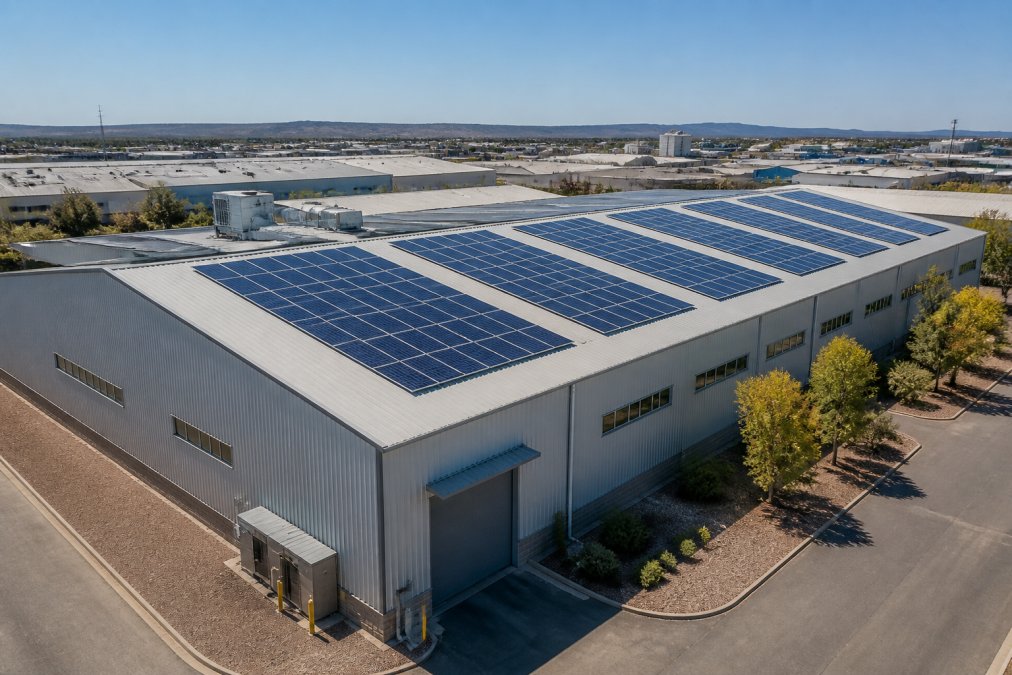
The verdict depends heavily on how the system is structured. A system financed through a third-party lease or power purchase agreement can complicate a sale, because the new owner inherits the contract. An owned system transfers cleanly and adds the full value to the asset, the single most important factor in whether commercial solar boosts your property’s worth.
How to Calculate Commercial Solar ROI for Your Building
The ROI calculation for a commercial property owner differs from that of a business owner offsetting their own electricity bill. When your goal is property value, the payback period matters less than the system’s effect on net operating income (NOI) and its capitalisation rate, the two figures that drive how a commercial valuer prices your asset.
Start with the standard energy calculation: request twelve months of electricity bills, identify your average daily usage in kilowatt-hours, your peak demand charges, and your tariff structure. This determines the system size that delivers the fastest savings without exporting excess power at low feed-in rates. The simple payback formula, total installed cost minus applicable incentives, divided by annual energy savings, gives you the years until the system pays for itself.
The property-value calculation extends further. A commercial valuer typically applies a capitalisation rate to the building’s net operating income to estimate its market value. Solar improves NOI by reducing the electricity line item in the operating expense statement. For example, a system saving $20,000 per year in energy costs, capitalised at a rate of 7%, adds approximately $285,000 to the building’s assessed value, before any separate allowance for the depreciated value of the solar asset itself. This mechanism separates commercial solar from a mere cost-saving measure.
When briefing a valuer, provide the system’s annual energy savings figure and the inverter replacement schedule. Valuers who understand solar will adjust NOI and capitalisation rates accordingly; those who do not may undervalue the asset unless you present the data clearly.
The capitalisation rate itself can also shift. Buildings with lower operating costs and modern energy infrastructure are often viewed as lower-risk investments, which can compress the rate applied by the valuer. A lower rate on a higher NOI produces a compounding effect on property value, why two otherwise identical buildings, one with an owned solar array and one without, can appraise for meaningfully different figures.
Do not size the system to cover 100% of consumption. Most commercial tariffs make the first 70-80% of offset highly valuable and the final 20% far less so, because export feed-in tariffs are typically a fraction of the retail import rate. A system that regularly exports to the grid extends your payback period and dilutes the NOI improvement that drives valuation.
The calculation only works if the assumptions are realistic. Shading from nearby structures, roof structural integrity, and building orientation all affect actual output. A professional site assessment should model these variables before you commit to a capital expenditure figure, and confirm that the roof’s remaining life aligns with the solar array’s 25-year operational expectancy, a roof replacement mid-system-life adds unplanned costs that erode the NOI benefit.
The Tenant Appeal of Solar-Equipped Commercial Buildings
Solar-equipped commercial buildings hold genuine tenant appeal, but the mechanism depends entirely on your lease structure. In a gross lease, where the landlord pays operating expenses, the solar savings flow directly to you as the building owner. In a triple net (NNN) lease, the dominant structure for industrial and warehouse properties, the tenant pays operating expenses including electricity, so the solar array reduces the tenant’s outgoings, not yours. This distinction determines how you should position solar in your leasing strategy.
In a NNN lease, the tenant appeal is straightforward: lower utility bills make your space more competitive than neighbouring options. Tenants comparing industrial sites will frequently favour the building with lower projected energy costs, because those savings flow straight to their bottom line. This translates into shorter vacancy periods and stronger tenant retention.
The property-value benefit in a NNN scenario comes from marketability and lease terms, not from the energy savings themselves. A solar-equipped building in a tight industrial market can justify a higher base rent per square metre, because the tenant’s total occupancy cost, rent plus operating expenses, remains competitive against non-solar comparables. This total occupancy cost argument is the most effective leasing pitch for solar-equipped commercial property.
In a NNN lease, solar shifts the negotiation from price per square metre to total occupancy cost. The landlord captures value through higher base rent or faster leasing, while the tenant captures value through lower utility bills. Both parties win, but the lease must be structured to reflect this.
A second consideration is the utility cost pass-through mechanism. In many NNN leases, electricity is paid by the tenant directly to the retailer, so the solar array simply reduces the tenant’s external bill. In other structures, the landlord pays the utility and passes the cost through based on pro-rata share. In the latter case, you must decide whether to pass the solar savings through to the tenant or retain them as additional income, a decision that should be documented in the lease agreement before installation, because it directly affects the building’s NOI and valuation.
The appeal extends beyond dollars. Many businesses now carry their own sustainability targets and report on their carbon footprint to customers and investors. Leasing space in an energy-efficient building helps them meet those obligations without capital outlay, translating into a broader pool of prospective tenants, particularly among corporate occupiers with formal environmental, social, and governance (ESG) procurement criteria.
This dynamic is particularly pronounced for industrial and warehouse tenants running energy-intensive operations. A building that shaves meaningful dollars off their electricity bill each month becomes a strategic choice, not just a property decision.
Understanding Commercial Solar Tax Incentives in Australia
Commercial solar tax incentives in Australia operate through two main channels: accelerated depreciation deductions and Small-scale Technology Certificates. The depreciation mechanism, governed by the ATO, allows businesses to claim a deduction on the system’s cost over its effective life, with the potential for accelerated deductions under specific provisions. These rules change periodically, so current guidance from the Australian Taxation Office on depreciating assets should be your first reference point.
The incentive landscape is not uniform. Eligibility depends on your business structure, the system’s capacity, and whether the property is owner-occupied or leased. Commercial property owners should also consider how the system interacts with their building’s overall tax position, since depreciation can offset taxable income in the installation year and beyond.
Do not assume the incentives available for residential systems apply to commercial installations. The certificate schemes and depreciation rules differ, and misapplying them can trigger an ATO review. Confirm your eligibility with a qualified adviser before committing.
Because incentives and rules shift with each federal budget cycle, the professional approach is to model your commercial solar ROI under current rules and revisit the calculation if policy changes. A reputable installer will factor the applicable incentives into your proposal rather than quoting a generic price.
Key Factors That Influence Your Solar System’s Performance
The performance of a commercial solar system depends on four variables: building orientation, roof structural integrity, shading, and ongoing maintenance. Orientation determines how many hours of direct sunlight the array receives across the year, while roof integrity dictates whether the roof can carry the additional load of panels and mounting frames. Both must be assessed before installation, not after.
Shading is the factor most often underestimated. A single neighbouring structure casting shadow across part of the array during peak hours can reduce total output disproportionately, because modern systems are only as strong as their most shaded string. A professional design accounts for seasonal sun angles, not just the midday position. The Clean Energy Regulator’s guide to solar system performance provides a useful overview of the standards expected of accredited installations.
Maintenance is the final factor, and the one owners neglect most. Panels accumulate dust and debris, inverters degrade, and connections loosen over time. An annual inspection and cleaning schedule keeps output close to the design specification, while neglected systems silently lose efficiency year on year. Factor a maintenance line into your operating budget from day one.
Solar Financing vs. Ownership: Which Model Builds More Value?
Ownership builds more property value than financing, and the gap is significant. When you own the system outright, the full asset transfers with the building, the energy savings flow entirely to the owner, and the property appraisal reflects the improved net operating income without complication.
Financing models have their place, particularly for businesses that cannot fund the capital expenditure from cash reserves. A commercial loan spreads the cost over the system’s life while retaining ownership benefits. A lease or power purchase agreement, however, transfers the savings to a third party and can complicate a future sale, because the buyer must either assume the contract or buy out the remaining term.
| Ownership Model | Who Gets the Savings | Impact on Sale | Best For |
|---|---|---|---|
| Outright purchase | Building owner | Full asset transfers, clean sale | Owners with capital available |
| Commercial loan | Building owner (after repayments) | Full asset transfers, loan must be settled | Businesses spreading upfront cost |
| Lease / PPA | Third-party provider | Contract must be assumed or bought out | Owners avoiding capital outlay |
The choice comes down to your time horizon. If you plan to hold the property for the system’s full payback period, financing can work well. If a sale is possible within the next few years, ownership avoids the contractual friction that can delay or discount a transaction.
Insurance and Risk Mitigation for Commercial Solar
Commercial solar introduces specific risks that standard building insurance may not automatically cover. Panel damage from hail, inverter failure, and electrical faults all carry different risk profiles, and your policy should reflect the replacement value of the array, not just the building. Reviewing your coverage with your insurer before installation prevents costly gaps later.
Risk mitigation starts with installation quality. A system mounted and wired to Australian standards is less likely to fail, less likely to cause roof damage, and more likely to perform to specification. The Standards Australia guidelines for electrical installations set the benchmark for safe commercial solar workmanship. Workmanship also affects insurance premiums, since insurers price risk partly on the quality of the installation.
Ask your installer for the system’s electrical compliance certificate and warranty documentation before handover. These documents are essential for insurance claims and for any future property sale, where buyers will request them as part of due diligence.
Beyond insurance, consider the maintenance contract. A system serviced annually, with documented inspection records, holds its value better and presents fewer surprises during a property transaction, supporting the valuation premium you are seeking.
Final Assessment: Is It Worth It for Your Property?
Commercial solar is worth it for most property owners, provided the system is owned, correctly sized, and professionally installed. The combination of reduced operating expenses, improved net operating income, and genuine tenant appeal creates a measurable uplift in property value that compounds over the system’s operational life.
The decision comes down to execution. A poorly designed system on a shaded roof with an unfavourable lease structure will disappoint. A professionally designed and owned system on a suitable building will deliver reliable savings and enhance the asset’s marketability. The difference is not solar itself, but how it is approached.
For property owners weighing this decision, the practical next step is a professional site assessment that models your specific consumption, roof characteristics, and payback period. This guide from MLG Electrical & Solar reflects our decade of experience designing and installing commercial systems across South Australia. Our team of qualified electricians prioritises technical accuracy over salesmanship, so you receive a system sized for your actual needs. Contact us to discuss whether commercial solar is the right investment for your property.
Frequently Asked Questions
Does installing solar panels increase the capital value of commercial premises?
Yes, evidence indicates that solar installations can increase capital value. The increase depends on factors like system size, age, performance, and ownership structure. A well-maintained, owned system reduces future operating costs, which appraisers may factor into a higher valuation. To maximise the impact, keep system documentation, maintenance records, and performance data organised. For a specific estimate relevant to your property, consult a commercial property valuer who understands renewable energy assets.
How do commercial solar systems influence property appraisal and marketability?
A solar system can improve a property’s energy profile and lower its net operating income. This makes the building more attractive to buyers and investors focused on long-term yield. In a competitive market, this increased marketability can shorten vacancy periods and may support a higher sale price. Buildings with solar often appeal to tenants with sustainability targets, giving owners a distinct advantage when marketing the space.
What are the long-term financial benefits of commercial solar for property owners?
The main benefits are utility cost reduction, which lowers operating expenses, and a hedge against future electricity price rises. Over time, the savings can cover the initial capital expenditure and provide a solid return on investment. Additionally, the system adds to the property’s asset value and can make lease terms more attractive. The financial case is stronger when you own the system and can capture the savings and any generated energy credits directly.
Do commercial tenants pay more for properties with solar energy systems?
In many cases, yes. Commercial tenants are often willing to pay a premium for solar-equipped buildings because it helps them meet corporate sustainability goals and manage their energy costs. This is especially true for tenants with net-zero targets. Lower projected outgoings for electricity make your lease offer more compelling. The ability to offer a ‘green’ building can be a deciding factor that helps you secure and retain high-quality tenants.